Guide

Your Practice Is Losing $20K Monthly Because You're Billing 99213s for 99215 Work

Mental health practices lose thousands monthly not from lack of patients, but from consistently billing below the complexity their documentation supports.

Article Image

Mental health practices lose thousands monthly not from lack of patients, but from consistently billing below the complexity their documentation supports. Most psychiatrists and therapists default to lower CPT codes even when their clinical notes justify higher reimbursement levels. This widespread undercoding comes from time pressure, documentation gaps, and simple unfamiliarity with billing optimization. AI-powered coding intelligence is changing that equation by analyzing clinical notes in real time, identifying missed billing opportunities, and ensuring every session is coded to match its true complexity while staying within payer requirements.

Photo of doctors working

The revenue drain nobody talks about

Most mental health clinicians leave money on the table every day. Not because they are undercharging or seeing too few patients. They are undercoding.

A psychiatrist spends 35 minutes managing medications for a patient with treatment-resistant depression, adjusts three prescriptions, discusses side effects, and provides supportive therapy about medication adherence. Then bills a 99213 when the visit clearly qualified for 99215 plus a psychotherapy add-on. That is potentially $80-120 in lost revenue for that single session.

Multiply that across a month of appointments, then across multiple providers, and you are looking at five figures in missed revenue. The work was done. The documentation was already there. The billing just did not match the clinical reality.

“The difference between compliant upcoding and illegal billing fraud comes down to documentation. If your notes support the code you are billing, you are doing it right. If they do not, you are creating liability.”

This pattern repeats in psychiatric and therapy practices because clinicians face legitimate pressures that make accurate coding difficult. Time constraints mean providers rush through billing selections. Complexity gets underestimated when the focus is on patient care rather than revenue. Many clinicians simply do not realize their documentation supports higher codes, or they avoid billing psychotherapy add-ons because they are not confident about payer requirements.

Compliant upcoding vs. fraudulent billing

Illegal upcoding means billing a 99215 when your documentation only supports a 99213. That is fraud.

Compliant upcoding means recognizing when your documentation actually supports a 99215 but you have been defaulting to 99213 out of habit or uncertainty. That is accurate billing.

AI coding tools focus on the second scenario. They analyze clinical documentation for elements that justify higher codes: medical decision making components, psychotherapeutic content, time thresholds, risk assessments, medication management complexity, and functional status documentation. When those elements exist in your note, the system prompts you to consider the higher code that matches your documented work.

This is about accuracy. Payers expect you to bill for the complexity you document. When you consistently undercode, you are providing charity care that nobody asked for.

Psychotherapy add-on codes

This is where practices miss the most revenue. Add-on codes 90833, 90836, and 90838 allow billing separately for therapeutic intervention delivered during medication management visits. Many psychiatrists never use them despite regularly providing therapy alongside med management.

Why? Because they think of themselves as “just doing med management” even when they are clearly delivering therapeutic interventions. A typical session might include CBT strategies for anxiety, motivational interviewing around medication adherence, supportive therapy for life stressors, or coping skills training for symptom management. All of that qualifies for psychotherapy add-on billing when documented properly.

AI systems detect this therapeutic content by scanning notes for keywords and clinical patterns indicating psychotherapy was delivered: cognitive restructuring, behavioral activation, exposure planning, mindfulness techniques, problem-solving strategies, or therapeutic alliance building. When present, the system suggests the appropriate add-on code.

The revenue difference is real. A 99214 plus 90836 add-on can reimburse 40-50% more than a standalone 99214. For a psychiatrist seeing 20 patients per week where half the sessions include therapeutic content, that is roughly $ 1,500-2,000 in additional monthly revenue that was already earned but never billed.

E&M code selection: 99213 vs 99214 vs 99215

The reimbursement gap between evaluation and management codes creates significant revenue variation. A 99213 might reimburse $90 while a 99215 reimburses $180. That is a $90 difference for work you may have already completed.

AI tools help clinicians navigate this by analyzing documentation for complexity markers: medication changes or titrations, multiple diagnoses being actively managed, laboratory monitoring, coordination with other providers, and documented risk factors like suicidality, homicidality, psychosis, or substance intoxication. The presence and combination of these elements determine which E&M level is appropriate.

Most clinicians underestimate their documentation. Making a medication adjustment, discussing side effects, reviewing lab results, assessing suicide risk, and coordinating with a therapist in a single session easily supports a 99215 in many cases. Without systematic analysis, providers default to their habitual billing pattern regardless of session complexity.

AI removes the guesswork. It maps documented elements against the requirements for each code level and suggests the highest defensible option, ensuring billing matches the documented workload while holding up to audit.

Therapist revenue optimization

Therapists face similar undercoding patterns. The main revenue leakage points: insufficient time documentation, underdocumented treatment interventions, missed crisis code opportunities, and failure to bill for collateral sessions with family members.

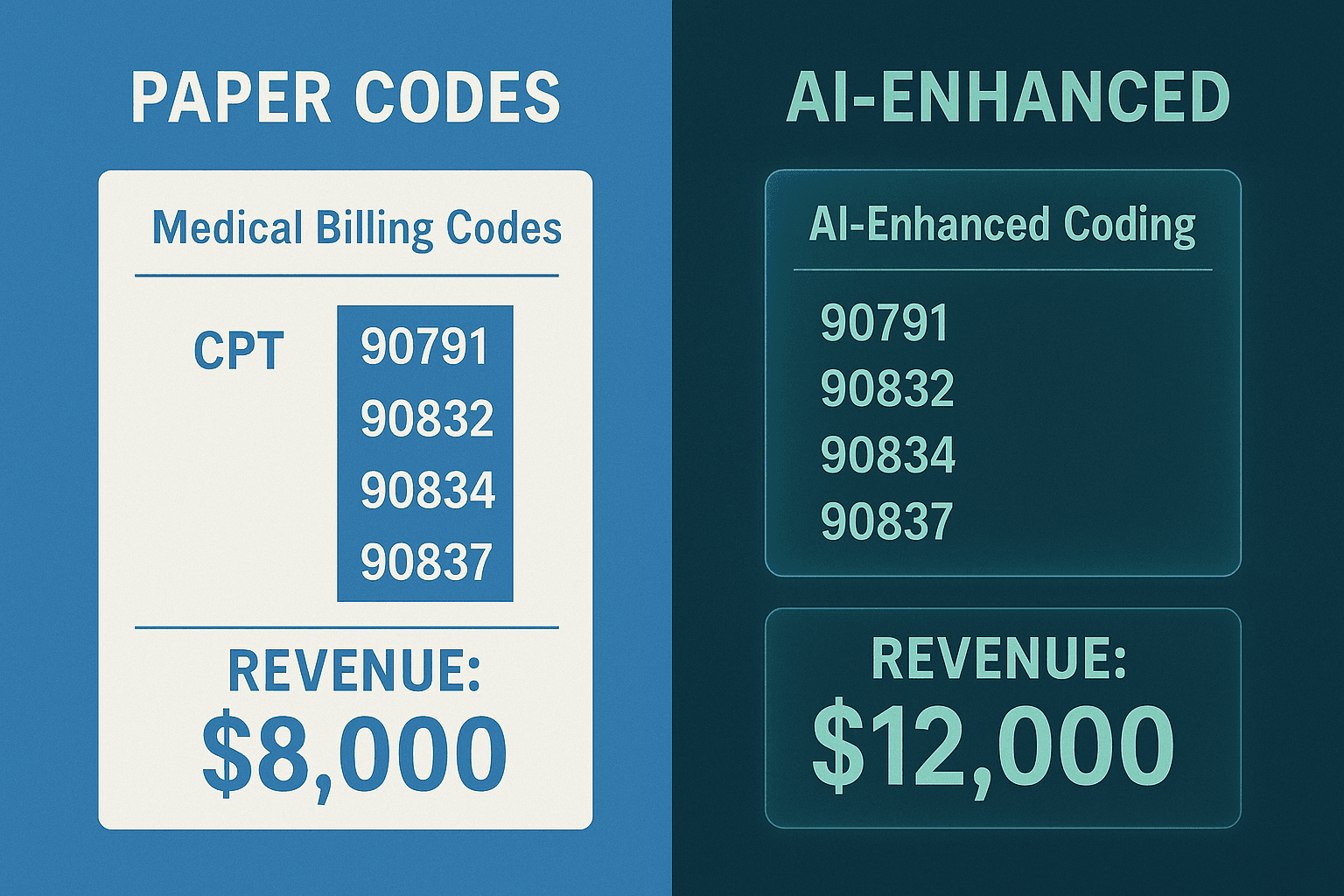
The 90834 versus 90837 distinction hinges on time: 38-52 minutes versus 53+ minutes. Many therapists bill 90834 by default even when sessions regularly exceed 50 minutes. That is typically a $30-40 difference per session. For a therapist seeing 25 clients weekly with several extended sessions, that is $ 300-400 in monthly underbilling.

AI documentation tools can track session duration and prompt therapists when time thresholds support higher codes. They also strengthen intervention documentation by ensuring clinical notes include specific techniques used, progress toward measurable goals, treatment plan updates, and risk assessments.

Crisis codes are another missed opportunity. When a therapist spends significant time managing acute suicidality, severe anxiety episodes, or other crisis situations, specific crisis intervention codes may apply. Most therapists are not aware of these options or do not document crises with enough detail to support the codes. AI systems can flag crisis content and suggest appropriate billing.

Audit-proof documentation

Revenue optimization means nothing if it creates audit vulnerability. The documentation must support every code billed.

AI-enhanced documentation systems build defensible clinical notes by ensuring all required elements are present. For higher E&M codes, that means clear documentation of medical decision making, including the number and complexity of problems addressed, data reviewed, and risk levels managed. For psychotherapy add-ons, therapeutic content must be explicitly documented with specific interventions and patient responses. For time-based billing, start and stop times or total duration must appear in the note.

The system also ensures treatment plans are updated appropriately, risk assessments are completed when clinically indicated, and medication changes include clear rationales. This creates a documentation trail that supports optimal coding and improves clinical quality.

When audits occur, practices using AI-supported documentation typically fare better than those relying on rushed, incomplete manual notes. The systematic approach creates consistency across providers and ensures payer requirements are met.

What revenue gains actually look like

Practices implementing AI coding intelligence typically see measurable financial improvement within the first month. The most common outcomes include a 20-40% revenue increase per visit through accurate code selection, 30-60% more psychotherapy add-on codes captured, reduced claim denials, fewer clawback requests from payers, and more equitable CPT distribution across providers.

For a three-provider psychiatry practice where each clinician sees 80 patients monthly, a 25% revenue increase per visit translates to roughly $15,000-20,000 in additional monthly revenue. Annually, that is $180,000-240,000 in previously missed reimbursement for work already done.

The gains compound as providers become more aware of documentation requirements and billing opportunities. What starts as AI-prompted improvements eventually integrates into clinical workflow, creating lasting change rather than temporary bumps.

Mental health practices operate in an environment where demand vastly exceeds supply. You do not need more patients. You need to be paid accurately for the work you are already doing. When your documentation reflects the true complexity of patient care, your billing should match that reality. Compliant upcoding supported by complete documentation is not just ethical, it is necessary for financial sustainability in modern psychiatric and therapy practices.

See it on your workflow

Twenty minutes, one mock visit. You leave with a note in your template.

We run a mock session live, draft the note, and walk through what the downstream claim would look like. No slides. No sales deck.

Live in 2 weeks or less BAA signed by default 30-day money back